Inside THE OUTER LIMITS Part Two: Tales from the Inner Mind

Welcome back, freaks! If you haven’t read the Good Doctor’s deep dive into TOL Season One—Inside THE OUTER LIMITS Part One: “Awe and Mystery”—please do that now and then head on back here…
…By the conclusion of The Outer Limits’ first season, change was already in the wind. The ratings for the show were very solid, yet it was obvious that the ABC Network had little idea what the show actually was. Advertisers didn’t know what to make of it and the more controversial episodes like “The Zanti Misfits” and “Hundred Days of the Dragon” ignited a negative response among network affiliates. There was a feeling that the show was too strange and had gone too far.
Joseph Stefano knew which way the wind was blowing, and it wasn’t his way. He was not in the mood to compromise on his more Gothic, horror-influenced storytelling, so he made the decision to pull up stakes and leave town. But before he left, he gave The Outer Limits its most enigmatic and stylistically bizarre episode as a parting gift. “The Form of Things Unknown” wound up being a big middle finger to the more conventional minds running the network.
This episode is just as bizarre today as it was in 1963. Stefano originally conceived of it as the pilot for a different show called The Unknown, but when that pilot was rejected, he had it shown as the last episode of the first season. It’s amazing it even got that far, as ABC executives called it “incomprehensible”, which is really not far off the mark.
The show begins with two women, Lenore and Kassia, scheming to kill the cruel and sadistic playboy Andre, who is planning to blackmail Lenore’s rich father. They managed to poison his drink with the leaf of the deadly “Thanatos” plant. They stuff Andre’s body in the trunk of his car and look for a suitable place to bury him. But they get caught in a tremendous thunderstorm and the car stalls in the middle of nowhere. The two make their way to a mansion being tended by a blind man. Already things are surreal and expressionistic, but the episode’s weirdness is just getting started.
The mansion is also inhabited by a strange, almost child-like inventor named Tone Hobart (played by David McCallum, who was so great in “The Sixth Finger”). Hobart has found a way to “tilt” time using the strangest time machine ever conceived…a room filled with clocks, watches and timepieces with a web of wires tying them all together. It’s an incredibly strange image.
Hobart says he has brought himself back from the dead using the “tilter” and apparently, he has found Andre’s body and brought him back to life as well. This starts a twisted cat-and-mouse game between Andre, the women, and Hobart that resolves itself in a nebulous way.

Stefano couldn’t have come up with a better kiss-off (and piss-off, as well) than this episode. Even for The Outer Limits, it was boundary-pushing and odd to look at. With this episode, Stefano took his leave and the show never again had quite the same dark and gloomy atmosphere.
The network replaced Stefano with veteran TV man Ben Brady, whose directive from his bosses was to reign in the more bizarre and extravagant aspects of the show. Brady didn’t have the flair for strangeness that Stefano had, but he was receptive to original ideas. The budget was cut drastically for Season Two, which was blatantly obvious at times. With Stefano’s Gothic leaning now out the window, the shows had a flatter look, more like a police procedural, with many episodes set in laboratories and military bases.
Unfortunately, the biggest change was the timeslot for the program. Season One had done pretty well on Monday nights, but for Season Two, it was moved to Saturday nights…opposite the most popular comedy show on television, The Jackie Gleason Show. This new slot was nothing less than a death sentence and a sure indicator that ABC bigwigs didn’t want to deal with the issues caused by “that weird sci-fi show”.
The “death slot” worked all too well and The Outer Limits was cancelled mid-season, resulting in just 49 episodes for the whole program. Yet despite all the problems with the second season, the show was far from a wash and, indeed, some of the most memorable episodes were to be found there.
This was evident with Season Two’s very first program, “Soldier”, written by a maverick young author named Harlan Ellison. The notoriously difficult Ellison would go on to be one of the most acclaimed science fiction writers of the ‘60s and ‘70s.
“Soldier” was a solid episode that featured a superb performance by Michael Ansara as Qarlo Clobridney, a human killing machine from a war 1000 years in the future who is transported to Los Angeles of the 1960s. A very dangerous stranger in a strange land, Qarlo is almost incomprehensible to contemporary humans, until a language specialist played by Lloyd Nolan starts to break through just a little bit.
Qarlo is invited to live with the translator’s family to help him adapt. Ansara is outstanding as the soldier from the future who talks to cats and seems ready to go off at any second. He seems to finally be on the verge of a breakthrough when an enemy soldier from the future arrives, setting up a powerful finale.
“Soldier” was the first of two Ellison scripts to appear in Season Two. The second and more famous Ellison episode was “Demon with a Glass Hand”, acknowledged by many as one of the best SF adaptations ever filmed for TV.
Here was a show just as dark and original as anything from the first season, with Robert Culp returning for his third Outer Limits appearance. This time, Culp plays a man named Trent who is being hunted by pasty-faced aliens in an abandoned office building in downtown Los Angeles. Trent’s memories are imperfect and he doesn’t know why the alien Kyban are after him.
His left hand is a strange mechanism resembling a hand with glass fingers. The hand can speak but has only two fingers. The Kyban have the rest. When the hand has all five fingers, it can reveal the truth of Trent’s identity and the reason why he has been sent 1000 years into the past.

The episode is a gloomy film-noir cat-and-mouse chase between Trent and the Kyban in the dark and shadowy building, which is surrounded by an impenetrable forcefield. Trent encounters an innocent female garment worker accidentally left inside who helps him in his battle. Ultimately, Trent receives a devastating revelation when he acquires all the fingers for his glass hand.
Ellison was known to fly off the handle if his scripts were changed by TV personnel. He had a lifelong vendetta against Star Trek because of disagreements over his Trek episode “The City on the Edge of Forever”. Years later, Ellison sued director James Cameron for plagiarism, claiming The Terminator stole ideas from both “Demon with a Glass Hand” and “Soldier”. There’s a pretty good case to be made for that assessment; the issue was settled out of court for an unknown amount and Ellison’s name being added as an “inspiration” for The Terminator.
With its complex plot, deep shadows and minimalist piano score, “Demon with a Glass Hand” is unlike any other Outer Limits episode. In a very rare occurrence, Harlan Ellison seemed to be pleased with the adaptation of both of his stories. Unfortunately, the quality of the two Ellison-penned episodes was not indicative of the season as a whole.
Each second season episode had a solid concept behind it, but execution was uneven. For example, “Expanding Human” dealt with consciousness-enhancing drugs creating a superhuman but immoral being. That sounds intriguing but the resulting program came across flatly and featured the worst cheat ending of the entire series.
Related Content:
Scripts from the Crypt: Horror Anthologies Part 1
Rabid Genius: Harlan Ellison Eulogized
Inside THE OUTER LIMITS Part One: “Awe and Mystery”
A similar fate befell “The Invisible Enemy”, which had the first astronauts on Mars being killed by an unseen menace. It would have been better if the creature…a kind of reptilian shark lurking beneath the sand…had really stayed unseen or at least barely glimpsed. The actual monster, a toothy puppet with goofy crab claws, is seen so much that the whole premise of the episode is dismantled.
A polarizing episode that is one of my personal favorites was “Cry of Silence”. This one had Eddie Albert and June Havoc stranded in the desert Southwest, menaced by tumbleweeds possessed by an alien intelligence. The force behind the tumbleweeds later takes control of thousands of frogs and giant boulders as well. June Havoc’s screaming hysteria is enough to drive most viewers crazy, but she is balanced by Albert’s excellent and full-blooded character, a man who tries to use logic to solve the puzzle and communicate with the invisible force.
The scene where the alien animates a dead body to try and communicate scared the living daylights out of me when I saw it as a kid and it still holds up today. Albert himself is ultimately taken over by the alien but the attempt at communication is thwarted by the being’s sheer strangeness. Some viewers thought the killer tumbleweeds were ridiculous and all agree Havoc is an annoying character, but I felt the message behind this episode made it one of the best.

One of the real triumphs of Season Two was The Outer Limits’ only two-part story, “The Inheritors”. The premise behind this one is great and the final revelation is absolutely amazing. It begins in Korea, when four American soldiers are shot in the head with bullets made from extraterrestrial metal. Instead of dying, the four all recover and find their IQs boosted to superhuman heights. The four then begin to work together on a secret project that takes them all across the world and involves them in criminal activity.
CIA agent Adam Ballard (Robert Duvall in his second TOL role) is assigned to track the four and see what they are up to. He discovers that their project involves kidnapping handicapped children. Although the four possess incredible power and intelligence, they themselves do not know the endgame of what they are doing. Ballard and his men finally track them…and the children…down, but the revelation of what is really going on changes the viewer’s entire perception of things. It was televised science fiction at its absolute best, with Duvall and Steve Ihnat as the leader of the mysterious four delivering outstanding performances.
One of the most unusual episodes of the entire series was “Behold, Eck”. We’re never really sure if this is a comedy or not. A nerdish and socially awkward optician is responsible for bringing Eck, a strange two-dimensional being, to our dimension. Eck is shown as a living cartoon with a sonorous voice and a kind personality.
Unfortunately, Eck’s mere existence in our realm causes disasters like skyscrapers being cut neatly in half. Only those wearing special glasses can actually see him. It’s up to the optician and his beautiful secretary to get Eck back where he belongs before the paranoid authorities catch up to him. The episode is rather stiff and mawkish, but Eck is a fascinating concept that gets the mind thinking.
“I, Robot” is not actually the Isaac Asimov story but a different tale by Eando Binder. Adam Link is a humanoid robot put on trial for the murder of its creator. Coming to Adam’s defense is a crusty old lawyer who at first is reluctant to take the case. The episode is notable for the appearance of Leonard Nimoy as a reporter covering the trial.
As the second season reached the 10-episode mark, it was pretty clear that cancellation was near. The Outer Limits was crushed by Jackie Gleason in the ratings, and the already reduced budget was taking another cut. The plug was pulled after “The Inheritors” double episodes, leaving just seven stories to be televised. The threadbare budget was apparent in each, but nowhere more than “The Duplicate Man”, an adaptation of a Clifford Simak story in which the monster alien known as the Megasoid is clearly the moth-eaten costume used for the first season episode “Second Chance” but with a ridiculous beak added.
With the writing on the wall, The Outer Limits finished its run with two cheap yet thought-provoking episodes. “The Premonition” was a unique time travel story, with Dewey Martin as a test pilot whose latest flight puts him and his wife 10 seconds into the future. The rest of the world seems to be frozen into place, but it is actually advancing one second for every half hour they experience.
They find themselves in a terrible dilemma when they see their young daughter frozen in the path of an oncoming truck. If they take her out of the path of the truck, that will mean they will be “out of phase” when they catch up to real time. A weird time phantom, forever stuck in limbo, shows up to demonstrate what will happen if they don’t catch up “in time”. This one is very clever despite its obviously low budget.

The final episode of the original Outer Limits was “The Probe” and although the special effects were glaringly cheap, the tale is ambitious and ends the series on a hopeful note. Four plane passengers are caught in a tremendous hurricane, and it seems they are doomed to die. But they wake up within a gigantic alien space probe that has gathered them up as “specimens”.
The probe is automated and without a crew. Its space trajectory will take it so close to the sun that the humans trapped aboard will be killed by radiation. Somehow, they must find a way to communicate with the probe’s creators and reveal that they are intelligent beings that must survive. But even if they break through, will the aliens reply?
Complicating matters further: the probe is infested with a mindless giant amoeba that tries to devour the four. Peter Mark Richman, who also starred in the first season episode “The Borderland” and who was in many genre shows of the ‘60s, is the leader of the humans. Although “The Probe” was not the greatest episode of The Outer Limits by a long shot, it was a good way to end the series.
With just 49 episodes completed, The Outer Limits completed its run and was expected to quietly vanish into the netherworld of failed TV series. Yet many scenes lingered in the memory of those who saw it and there was a demand for it in syndication. Even though there was just a season and a half of shows, it started reruns immediately. Often it wound up in late night slots on low powered local channels.
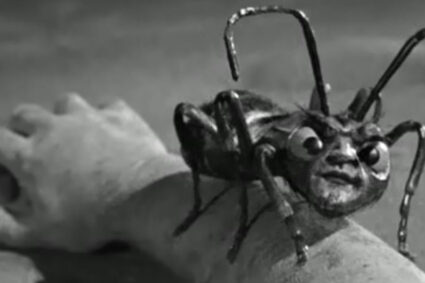
I missed it on the first run but saw some episodes in 1969 and 1970. What I did see traumatized me so much, I approached the show very gingerly from there on. The Thetan from “Architects of Fear”, the Zantis of “The Zanti Misfits” and bug-eyed Fowler of “The Mutant” particularly lingered in my brain.
When I watched the show again in my teenage years, I was a lot more sensitive to the excellent writing and imaginative concepts than the sheer horror I experienced as a child. The Outer Limits finally got released on VHS tape and then DVD, a more ideal way to see it than on local TV, which sometimes cut it for length and “taste”.
The legend has grown so much that by the mid-‘90s, the whole series was reimagined for syndication with an all-new Outer Limits. The new show tried very hard to keep the format of edgy, thought-provoking science fiction and at first, it did a pretty fair job. But the weird atmosphere and unique look of the original was lost.
The new Outer Limits had a very respectable run, from 1995 to 2002, and boasted some good episodes. But after the first two seasons, the stories began to blur together, and the aliens and monsters were nowhere near as memorable as the 1963-65 original. Strangely enough, the reputation of the older and much less prolific version totally eclipsed the longer and technically more successful modern update.

It won’t be long now until it will be seven decades since The Control Voice first took over your television set. Today, when the almost limitless special effects can portray things Leslie Stevens and Joseph Stefano could barely dream of, the shadow of the original Outer Limits still stretches from the inner mind to beyond infinity.