Inside THE OUTER LIMITS Part One: “Awe and Mystery”

There was one TV show from the early ‘60s that traumatized more children than any other. It wasn’t The Twilight Zone, it wasn’t One Step Beyond, and it wasn’t Alfred Hitchcock Presents. Was it Thriller, hosted by Boris Karloff? You’re getting warmer! That show certainly sent kids under the bed with episodes like “Pigeons from Hell” and “The Cheaters”.
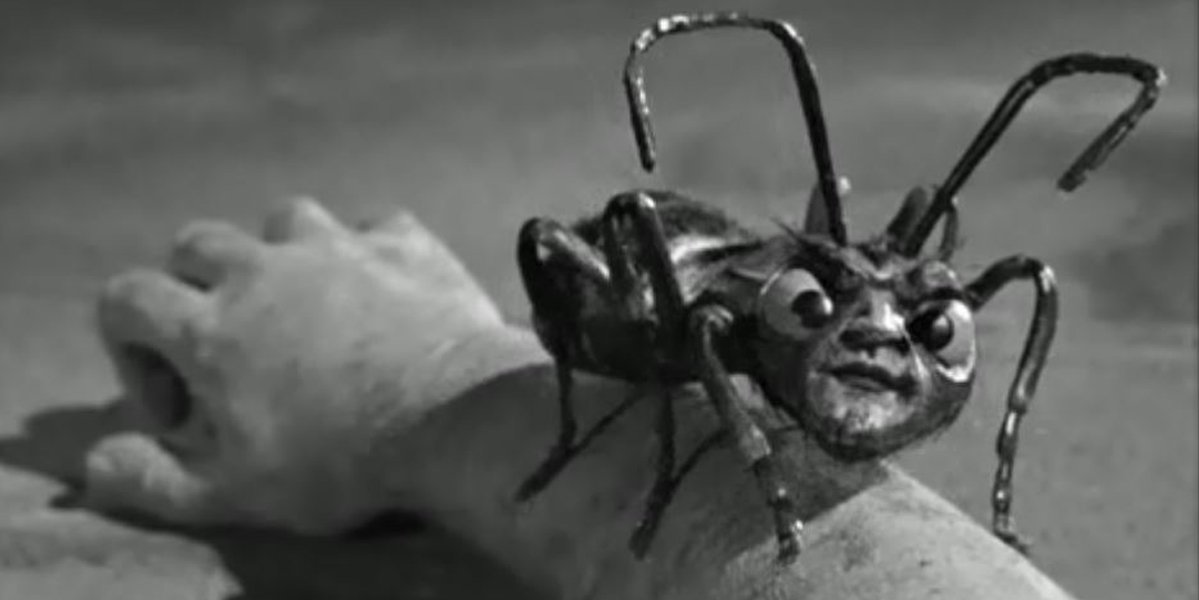
No, the real nightmare factory from the Golden Age of anthology television was The Outer Limits. There has never been another TV show like it. Not even the revival which ran for seven seasons in the 1990s. And out of all the disturbing episodes of The Outer Limits, one was the absolute apex of terror: “The Zanti Misfits”. Chances are, you have probably seen images of the title characters at some point…overgrown ants with malevolent human faces and huge, evil eyes. These twisted insects played on every human fear of crawling things and sent that fear through the roof. And if you were a grade-school kid watching this episode for the first time, you never ever forgot it.
I was one of those kids and I didn’t scare too easily. However, I was too young to see it on its first run in 1963, the year I was born. I saw it around 1970, and the Zantis traumatized me so badly that I didn’t watch another episode of The Outer Limits until the 1980s! It wasn’t just the look of these anthropomorphic bugs the size of guinea pigs…it was the infernal buzzing and chittering noises that accompanied their appearance. The sight of human soldiers covered by these hideous little monsters is still disturbing more than 60 years later.
The Outer Limits, especially in its first season, specialized in such uneasy scenes. The series was science fiction at its core, but the thrill of horror was never far from most episodes. The show was out to not just push the envelope but burn it to a crisp. The “alien” (actually a transformed human) in the episode “The Architects of Fear” was judged so terrifying by many TV stations that some of them blacked out its appearance, a remarkable bit of censorship that no other sci-fi or horror anthology has ever experienced, including Thriller and Night Gallery.
As monstrous as the Zantis were, there was a twist in their story that turned everything on its head. The Zantis sent to Earth were their criminals. The Zantis were incapable of killing their own kind. So, the misfits were sent to Earth where humans—”practiced executioners”—would do it for them. And that is exactly what happened. Who were the real monsters?
This remarkable show was the creation of basically two men…Leslie Stevens, a man who believed in keeping the science in science fiction, and Joseph Stefano, a man of very dark imagination, who was best known as the writer of the boundary-smashing Hitchcock film Psycho.
For the first and best season of The Outer Limits, these two very different men worked well together. They created a program that merged scientific plausibility with feverish Gothic horror. They wanted to push things to the limit of what American television could show and for the most part, they succeeded.
There were just 49 episodes in total for Outer Limits, far less than the usual amount needed for successful syndication…and yet the program has been in continuous visibility since it left the air in 1964. Very few who saw it ever forgot it, including Stephen King, who judged that “it was the best program of its kind ever shown on TV.”
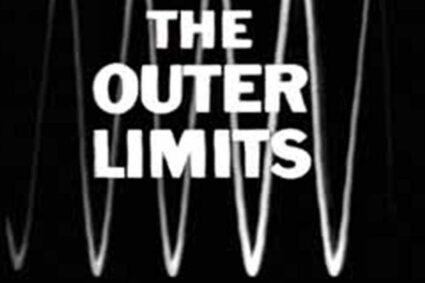
It was originally going to be called Please Stand By, but the network overruled that decision. The constant clash with ABC was to be a recurring theme for the show. Stevens and Stefano decided to be confrontational from the very first episode. The introduction for every show began with a shrill tone and the image of an oscilloscope. A neutral voice then made the following declaration:
“There is nothing wrong with your television set. Do not attempt to adjust the picture. We are controlling transmission. If we wish to make it louder, we will bring up the volume. If we wish to make it softer, we will tune it to a whisper. We will control the horizontal. We will control the vertical. We can change the focus to a soft blur or sharpen it to crystal clarity. For the next hour, sit quietly and we will control all you see and hear. You are about to participate in a great adventure. You are about to experience the awe and mystery which reaches from the inner mind to…THE OUTER LIMITS.”
It remains one of the most startling openings to any TV show. The Control Voice was provided by experienced radio actor Vic Perrin, who popped up all over early TV. The Control Voice also gave a specific opening and closing monologue to each episode. In the second season, the introduction would be significantly reduced.
Stevens and Stefano set some ground rules for the show’s writing. Stevens insisted upon a firm scientific basis for the stories…no supernatural horror or fantasy elements were allowed. But Stefano added a lot of the “weirdness” for which The Outer Limits became famous. He wanted each episode to have a “bear”—a monster or spectacular effect of some kind that would shock the viewer’s mind. He also injected a lot of the Gothic look of the first season, with a visual look drawn from German expressionism and French New Wave cinema. The combination of these two approaches made sure the program was like nothing else shown on TV, either now or then.
Despite the insistence on “monsters” for most of the episodes, that concept did not extend to the actual personality of the creatures. In ‘50s sci-fi, ugly-looking monsters were almost uniformly hostile. Not so on The Outer Limits. In many cases, the aliens and strange creatures were the victims and man was the monster.

The very first episode of The Outer Limits was perhaps the best illustration of this idea. “The Galaxy Being” remains one of the very best first-contact stories ever shown on TV. In this classic episode, the excellent actor Cliff Robertson plays a dreamy radio engineer who uses the power of a radio station to contact a strange alien composed of energy. The look of “The Galaxy Being” is brilliantly effective: an actor wore a shiny rubber suit covering his body which was then shot in negative. The result is startling.
Related Content:
TV Horror at its Best: Are You Ready for Boris Karloff’s THRILLER?
SAPPHIRE & STEEL: British TV’s Other Time Travelers
Maxwell’s first conversation with the Being is memorable, as the two discuss their differences and similarities, including a belief in God. “Do you have death?” asks Robertson’s character. “There is no death,” responds the being in its electronic voice. “Energy is forever.”
As you might expect, things go wrong. Due to a mistake by a careless DJ, the Being is actually transmitted to Earth, where his radioactive body causes havoc amongst the humans. In the end, he delivers a lecture to the primitives who wanted to destroy him, telling them “There is more to existence than you know”.
This was a great introduction to the show, introducing many of its core themes. In almost every episode that followed, there was some idea that challenged a prevailing norm. Many (but not all) of the episodes featured monstrous characters, especially in the first season. Some of them, like the Zantis and the super-evolved human of “The Sixth Finger”, have become iconic.
A constant theme of The Outer Limits was transformation, as characters underwent extreme and grotesque changes. The show tapped into body horror long before David Cronenberg specialized in it. Several episodes stand out for their takes on this theme: “The Architects of Fear”, “The Sixth Finger”, “The Mutant”, “A Feasibility Study”, “The Chameleon”, “Cold Hands, Warm Heart”, “Expanding Human”, “The Brain of Colonel Barham”.
“The Architects of Fear” is perhaps the most extreme—and most heart-breaking—of the show’s transformation episodes. Robert Culp, who appeared in three episodes all together, is part of a secret organization of scientists that wants to scare the world into lasting peace. To do this, they create a common enemy, an invading alien from the planet Theta. Culp is chosen at random to become the “Thetan”, undergoing massive physical changes that also unbalance his mind.
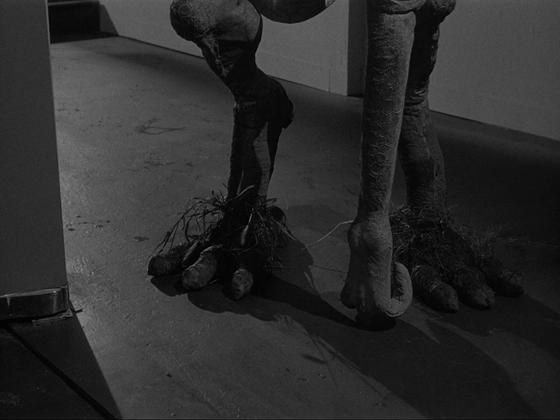
The phony “Thetan” is an absolutely grotesque creation with no similarity to a human being. A cross between reptile and insect, it hops along on three legs, has massive claws and a huge, scaly head. As one might expect, the scientists’ plan goes tragically awry and the Thetan’s “spaceship” lands off course. This pseudo-alien was considered so horrifying by many ABC affiliates that its appearance was mostly blacked out, leading to an incoherent story. Eventually, Culp’s character demonstrates its humanity during a touching moment with his wife, who believes he died in an accident.
“The Sixth Finger” is equally iconic and is recognized as one of the series best. David McCallum gives a standout performance as an angry Welsh coal miner who is turned into a super-evolved man of the future by a scientific process. His gradual evolution into a huge domed goblin-like superman is brilliantly realized. At one point he plans to use his advanced powers to wipe his home village off the map. But he manages to evolve beyond the need for vengeance. Again, it is the love of a good woman who gives a conclusion to the situation.
The title character in “The Mutant” was irredeemably evil. He was Reese Fowler, a member of an expedition to an alien world where the sun never sets. Caught in a strange silver rain, Fowler becomes a powerful telepath and a ruthless paranoid. Beneath his huge goggles are gigantic eyes blown up to the size of fried eggs. As played by Warren Oates, Fowler emerges as a truly terrifying presence, able to read every thought and capable of disintegrating his enemies. This was another episode that disturbed a lot of kids.
One of the most terrifying and yet uplifting episodes was “A Feasibility Study”. This one freaked me out just as much as “The Zanti Misfits”. A typical suburban neighborhood is physically yanked out of the Earth and transported to the hot, steamy planet of Luminos. The people have been brought there by the native Luminoids, a race afflicted with a horrible disease that turns them into immobile, rock-like creatures. They wish to see if humans would make suitable slaves and become their arms and legs. If so, they will transport the entire human population of Earth to Luminos.
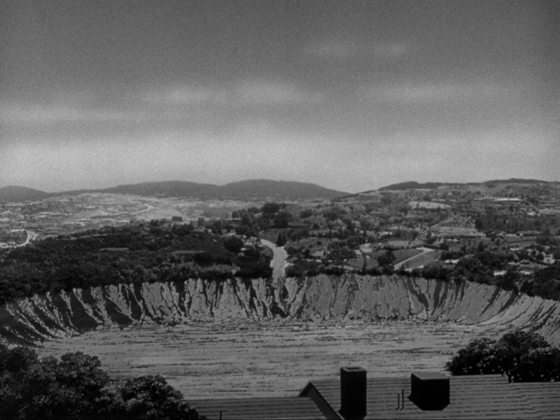
There’s an unforgettable scene of horror when one of the unsuspecting humans drives past the neighborhood into the mist-choked hell of Luminos. When his car finally breaks down, he is pursued by hideous zombie-like Luminoids. He turns to run in horror…only for the scabbed hand of a Luminoid to appear directly in front of the camera. That caused me to jump a mile when I saw this for the first time. The episode concludes with a monumental act of bravery on the part of the captives that foils the alien plot.
As I write this, the great actor Robert Duvall has been deceased for two days. Duvall got his start on The Outer Limits and appeared in two memorable episodes, “The Chameleon” and the two-part “The Inheritors” from season two. “The Chameleon” is one of the best episodes featuring a transformation. In many ways, it is kind of a reverse image of “The Architects of Fear”.
Duvall plays Louis Mace, a former assassin and CIA agent forced to live in exile in Mexico. Mace is a lonely, friendless man who nevertheless is an expert killer. He is recruited for his ultimate undercover assignment: he will impersonate an alien and infiltrate a UFO that has wiped out a band of soldiers. Mace’s transformation is as complete as the one Robert Culp endured in “The Architects of Fear”, although not as extreme. He does indeed make it onto the alien craft, but what happens from that point forward is totally unexpected. Duvall shows his great ability to disappear into a character as Mace. We’ll look at “The Inheritors” in Part Two.
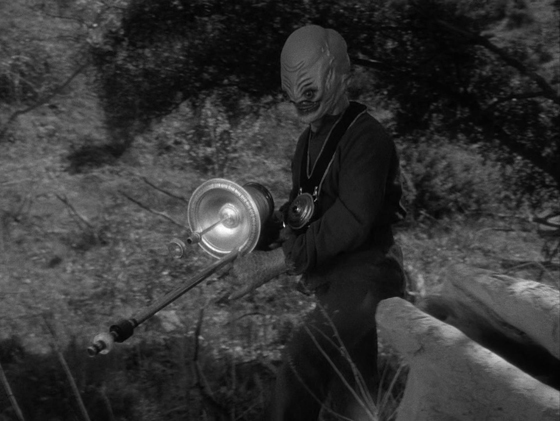
The episodes in which Stefano had more of a hand intended to be just as much horror as science fiction and they came across as a unique blend of classic horror tropes with a more clinical SF twist. One of the most overtly horror episodes was “Corpus Earthling”, right down to its very downbeat ending. Robert Culp, in his second Outer Limits role, is a man recovering from severe head trauma. The steel plate in his skull allows him to overhear two pulsating black rocks discussing their plan to take over humanity. When the alien rocks realize he can hear them, they target him for murder: “You must not tell, listener!”
The rocks can infect humans and turn them into zombie-like automatons that they can possess. There are some very nightmarish scenes where the wife of Culp’s character becomes one of these zombies, white haired and dark-eyed, hell bent on his destruction. This was The Outer Limits at its most ghoulish, a film noir combination of Invasion of the Body Snatchers and Night of the Living Dead.
Related Content:
Terror on the Air: Ten Terrifying Horror Shows from Radio’s Golden Age
FRANKENSTEIN: THE TRUE STORY Revealed!
One of the most bizarre episodes was “Don’t Open Til Doomsday”, a virtual frenzy of sexual symbolism and haunted house vibes. The story finds a young couple eloping from the bride’s stern father and hiding in a strange old house run by a grotesquely eccentric old woman. It seems that 35 years earlier, the landlady’s groom had disappeared on her wedding night, breaking her mind. In actuality, the groom is now within a small box…which contains a hideous blob-like alien in a timeless void.
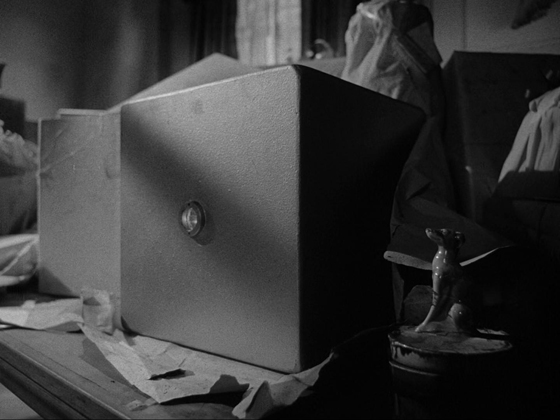
The alien is hell bent on destroying the entire universe while the crazed landlady believes she will get her groom back if she lets the creature have the young couple. It’s a twisted tale that almost seems like a combination of Psycho, Whatever Happened to Baby Jane?, and cosmic Lovecraftian horror. Nothing quite like it has ever been shown on TV.
The hotel of “Don’t Open Til Doomsday” is right out of a haunted house trope. That was also the case for another surreal episode, “The Guests”. A drifter finds himself imprisoned in a house where time has stood still and the residents have been trapped for many decades. Their “host” is a pulsating brain-like alien in the attic that is conducting experiments on them.
Not all haunted houses of The Outer Limits fit that trope as closely as those two episodes. In “It Crawled Out of the Woodwork”, the haunted house is a top secret scientific lab where death and madness dwell. A mad scientist has captured a demonic energy-being from space and uses it to control all who work there. This is a nightmarishly dark and oppressive tale, with a morbidity almost unknown on television.
Another science lab turned haunted house is the nuclear research facility in “Production and Decay of Strange Particles”. When an experiment with radioactive materials cracks open a hole in reality, a strange energy from the other side kills many of the workers and animates their now-empty radiation suits with blazing power. The scenes of the radioactive “ghosts” clustered together and working on incomprehensible tasks is the essence of cosmic horror…man’s fear of radioactivity literally given physical form.
The Outer Limits also had a distinctly political twist to some of its stories. “The Hundred Days of the Dragon” is unique in that it is almost entirely a political thriller that dares to show what happens when a popular presidential candidate is ruthlessly killed…and then imitated by a foreign spy who can change his appearance with the help of chemicals. The scene where the candidate is killed in his bed by his own duplicate is absolutely chilling. A few months after this episode aired, President Kennedy was assassinated. The episode was then removed from view until the 1970s.
Even more subversive is “The Invisibles”, where a secret society of highly placed individuals has already taken control of much of the US power structure. Members of the society are infected by alien monsters that resemble giant lice. The growling creatures are placed on a candidate’s back and injected with a stinger in what looks like a grueling process.
It is never really clear if the monsters are behind the takeover themselves or are just tools used by unscrupulous men. It’s one of the most paranoid episodes, where no one can be trusted to be who they seem to be…there’s a real Manchurian Candidate feel to this one. In 1963, very few TV shows dared to show the US as vulnerable to an inside takeover.
Perhaps the most prescient episode of the first season is “O.B.I.T.”, which takes the form of a congressional inquiry into severe morale issues at a top-secret government installation. The problems revolve around an invention called O.B.I.T. or “Outer Band Individuated Tracer”, which allows the user to spy on any one of his choosing. This has led to paranoia, depression and addiction to the device. “It’s the most hideous thing ever conceived,” says one character. “I can’t stop watching it!”
It shouldn’t escape the modern viewer that the machine has uncanny resemblance to the internet and the many surveillance technologies of our current era. In the episode, it turns out that “O.B.I.T.” is being used by an alien invasion force to weaken and demoralize the population. Of all the forward-thinking Outer Limits episodes, this might be the most chilling because of how realistic it is.
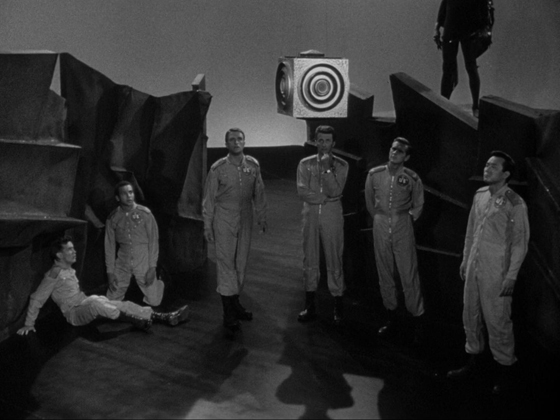
My personal favorite episode of the first season, if not the entire series, is “Nightmare”, which lives up to its stark title. In a future war with the mysterious planet Ebon, an international crew of Earth soldiers is captured and imprisoned in an Ebonite war camp. There they are subjected to various forms of mind control and torture. One character’s vocal cords are disabled, another is struck blind, and one has all the bones of his arm pulverized. Illusion and mental pressure are used and soon the P.O.W.s are fighting amongst themselves. Using minimalistic sets, this is a tense and suffocating drama with a shocking twist at the end that turns everything upside down. This was timeless television.
The first season of The Outer Limits is notable because virtually every episode had at least one shocking or indelible image. Not every episode was top quality. “Tourist Attraction” was a dud with its unlikeable characters and clunky looking monsters while “Specimen: Unknown”—ironically the highest rated episode—was tepid and typical ‘50s style SF that featured a space station taken over by flowers that spit lethal Rice Krispies…but very few TV shows could boast such a cornucopia of quality episodes.
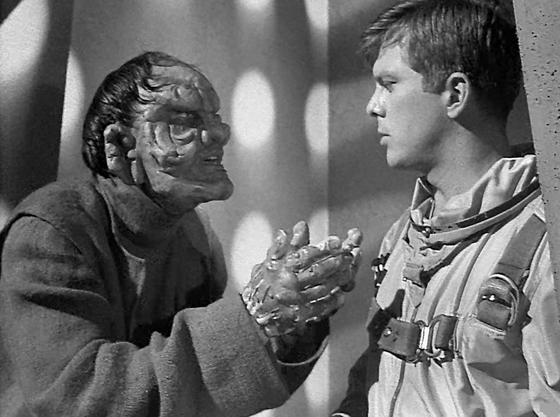
I would be remiss if I didn’t mention the two episodes that Oscar winner Martin Landau starred in. The tragic sci-fi fairytale “The Man Who Was Never Born” is a favorite of many fans. Landau plays Andro, a hideously deformed mutant of Earth’s atomic future who nonetheless has a kind and intellectual soul. Andro travels back in time to our era on a mission to kill the man who would later cause a worldwide holocaust…only to find himself falling in love with the mother of the yet unborn evildoer. Landau gives a wonderful performance, often under heavy makeup, as one of the show’s most tragic heroes.
Landau appeared again in “The Bellero Shield”, as a human scientist who accidentally brings a peaceful glowing alien to Earth. The hapless alien becomes a pawn in the schemes of the scientist’s dysfunctional family, which includes Bellero’s ruthless wife and glory-hungry father. This was a show that was almost Shakespearean in its human faults and frailties.
On the whole, The Outer Limits’ first season was ground-breaking in a way that many people couldn’t fully appreciate. Stevens and Stefano were always fighting battles with the network and advertisers over the content of the show, sometimes winning, sometimes losing. The constant stress became too taxing for Stefano, who left after the first season. With him went a lot of the Gothic atmosphere and moodiness of the best episodes. In the second season, the show would move from its cushy Monday night slot into a “death slot” on Saturday night where it would compete with the wildly popular Jackie Gleason Show. It would also find its budget cut.
In the second part of the article, we’ll look at that second season, which still managed to create some quality TV despite all the obstacles in its path…