Hemet, Or: The Landlady Don’t Drink Tea Movie Review


Welcome to Hemet. Not Helmet, mind you. Hemet. It’s a small little county in Southern California. It’s a county much like any in the US really. Work is hard to come by. Decent work is even harder. The rent keeps going up while the pay keeps going down and homeless folk prowl the street in search of people to eat. The damn Bath-Salt Pandemic is really doing a number on the homeless folk.
Granted the Bath-Salt problem isn’t relegated strictly to Hemet, after all it is a global phenomenon. But in Hemet the crisis feels particularly pronounced due to the presence of one Liz Topham-Myrtle, the landlady at a Podunk apartment complex in town.
Equally as vindictive as she is manipulative, Liz uses what little power she has to inflict cruelty on anyone who stands in her way. Or anyone who stands in her general vicinity.
Tensions grow ever higher between the tenants, the police, the cannibalistic homeless folk, and Liz herself. If something doesn’t give, things are likely to get real bad, real fast.
Hemet: or The Landlady Don’t Drink Tea (let’s just call it Hemet from here on out) is one of those movies that’s hard to wrap your head around. There’s no overall story to speak of, yet multiple plot threads weave in and out of one another leading toward an inevitable climax. Things go more or less exactly where you think they’re going to go, yet the path taken to get there is anything but predictable. It’s the kind of story that leaves you wondering just what the hell kind of movie is this?
The answer: It’s one of those movies. Hemet is the sort of one-of-a-kind, weirdo, off-beat slabs of the bizarre that can only come from the truly independent filmmakers of the world.
Director Tony Olmos and writer Brian Patrick Butler have crafted a story that follows its own rhythm. Not quite horror, not quite comedy, not quite drama, but also very much so all three of those combined. Equal parts Slice-of-Life and Torture Porn (with a sprinkling of Fairy Tales just for good measure), Hemet follows no rules beyond its own and demands that you accept it on those terms.
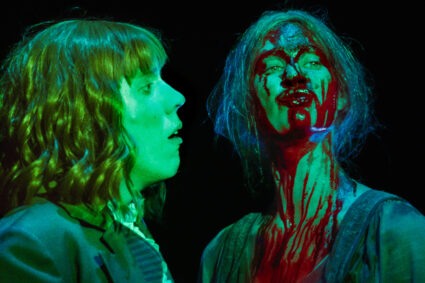
Interestingly, the backdrop of the movie might be its weakest element. Despite being the primary dramatic thrust of the story, the Bath-Salt zombies really don’t seem to have much to do with anything. They appear here and there, looking intimidating. We get news reports of the growing problem, but we never really see the carnage they are supposed to be causing.

In many ways, the whole pandemic element of the movie could be removed entirely and very little would be changed. But at the same time, the Bath-Salt zombies are kind of symbolic of the movie itself. It doesn’t seem like much is even happening, but an emotional toll is being taken, nonetheless. Hemet and its zombies manage to stick to one’s psyche. The stink lingers on everyone and everything, even if it’s not seen directly.
Related Content:
They Will Outlive Us All Movie Review
Amid the threat that may or may not be happening, the story really hinges on Liz Topham-Myrtle, portrayed by writer Brian Patrick Butler himself. The casting of Butler as Liz is an inspired choice. Absurd and nonsensical, but inspired, nonetheless. What was the thought process behind casting him in the role? Perhaps he and Tony Olmos were too shy to ask a nice old lady to say such horrible things.
Or maybe they feared the type of old lady that would say such horrible things.
Or maybe Butler just wanted to give himself the best lines of the movie.
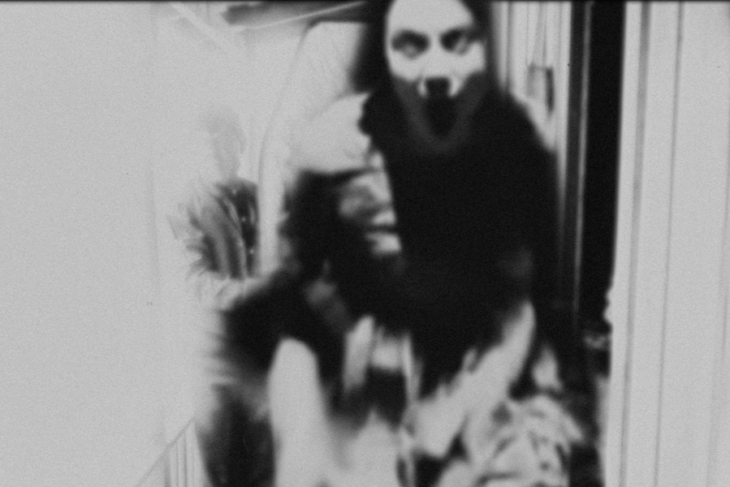
Some mysteries are best left unsolved. Regardless, Hemet is all the better for his performance. The prosthetic mask used to transform him into Liz is an uncanny visual. It acts as a tag-team with the pandemic aspect of the plot. Everything seems almost normal, but something is just slightly askew.
It’s all part of that unique rhythm Hemet’s got going. Could there be room for improvement in some part or another? Sure. Maybe the plot could be tightened up a bit. Maybe there could be some more action throughout the course of the movie. Any number of things could be “improved”.
But those little imperfections are what makes Hemet stand out. In a time when most stories follow templates, metrics, formulas, and screen-tests, there’s something refreshing about a movie that is willing to just be what it is. Warts and all.
It’s not the kind of movie that will slide easily into anyone’s Best-Of lists, but if you’re willing to accept it for what it is and trust it to take you where it’s going, Hemet: or The Landlady Don’t Drink Tea is one of the more interesting and unique movies to come out in the last few years.